 English
 Français
 Español
 Türkçe
 Italiano
 العربية
 Português (BR)

Latest articles
What a destiny matrix is, and what it is not
A destiny matrix is a chart built from one input: your date of birth. The day, the month and the year are each reduced to a number between 1 and 22, those numbers are added in a fixed order to produce further numbers, and every number is then mapped to one of the 22 major arcana. The result is drawn as an eight-pointed star — two overlapping squares — with a number sitting at each point and one number in the centre.
That is the whole mechanism. There is no hidden step, no random element, and no interpretation involved in producing the chart itself. Two people born on the same day get identical charts. This is worth saying plainly, because a lot of pages on this topic imply the calculation is mysterious. It is arithmetic, and we show it in full further down this page so you can check ours by hand.
What it is not: a destiny matrix does not predict events, does not diagnose anything, and has no scientific standing. It is a self-reflection framework — a fixed set of prompts derived from a date, useful in the way a personality questionnaire is useful. Read it as a set of questions about yourself, not as a set of answers about your future. Nothing here should inform a medical, financial or legal decision.
How the chart is calculated
Every number in the chart is produced by two operations: adding, and reducing to the 1–22 range. Reducing means that while a number is larger than 22, you replace it with the sum of its digits.
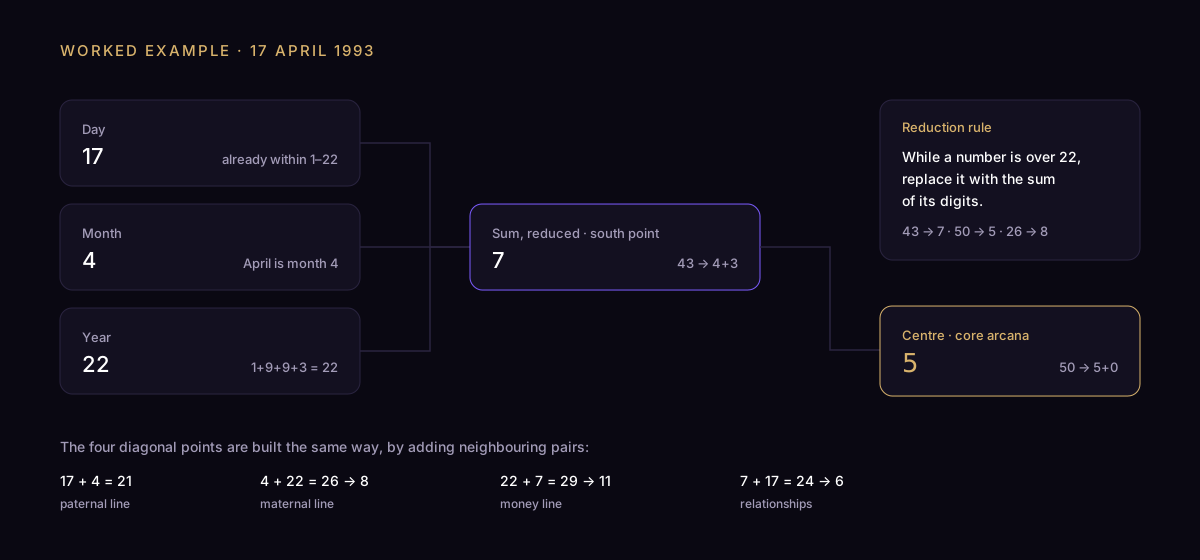
Worked example: 17 April 1993
We use a real date rather than a placeholder so you can follow every step and verify the calculator against it.
| Step | Arithmetic | Result | Position |
|---|---|---|---|
| Day | 17 is already within 1–22 | 17 | West — character |
| Month | April is month 4 | 4 | North — ancestral task |
| Year | 1 + 9 + 9 + 3 = 22 | 22 | East — talent |
| Sum | 17 + 4 + 22 = 43 → 4 + 3 | 7 | South — life purpose |
| Centre | 17 + 4 + 22 + 7 = 50 → 5 + 0 | 5 | Core arcana |
| North-west | 17 + 4 = 21 | 21 | Paternal line |
| North-east | 4 + 22 = 26 → 2 + 6 | 8 | Maternal line |
| South-east | 22 + 7 = 29 → 2 + 9 | 11 | Money line |
| South-west | 7 + 17 = 24 → 2 + 4 | 6 | Relationships |
So a person born on 17 April 1993 has arcana 5 — The Hierophant — at the centre of their chart. Put the same date into the calculator at the top of this page and you will get these nine numbers back.
If a calculator elsewhere gives you a different centre number for the same date, it is not broken and neither are we. Several schools reduce the year differently — some sum all four digits, some use only the last two. We sum all four, which is the more common approach. Whichever you use, be consistent, and do not compare charts built with different rules.
The nine positions and what each one asks
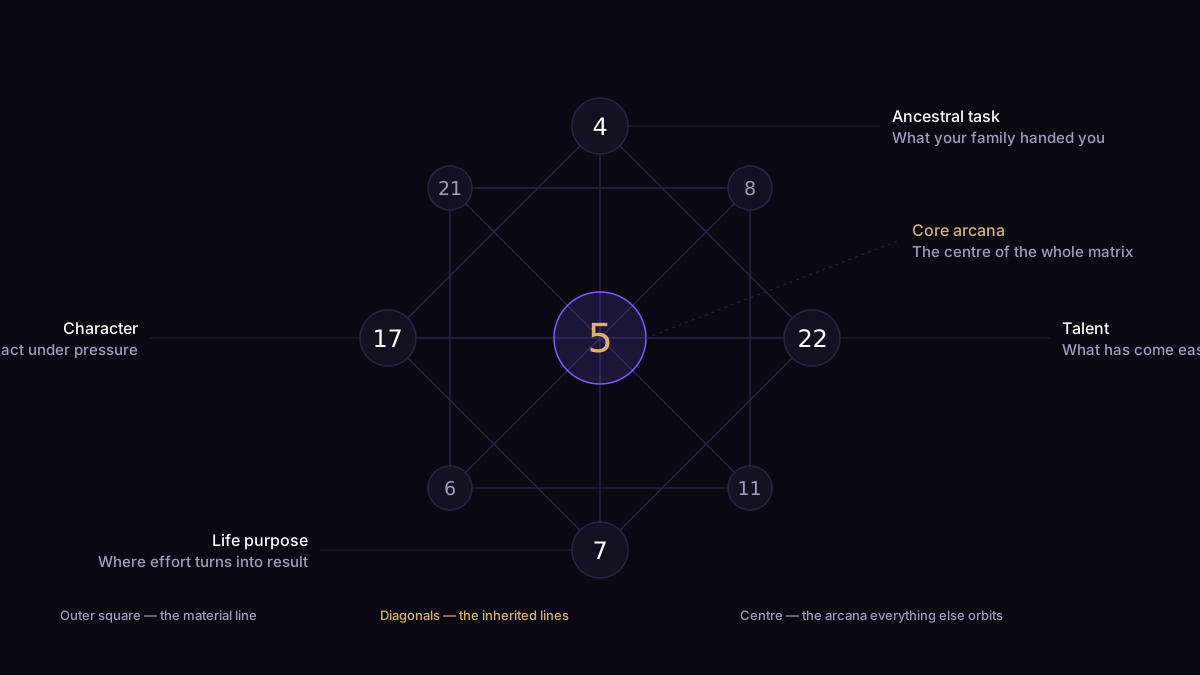
The outer square holds what the method calls the material line — the visible, practical side of a life. The diagonal square holds what was inherited. The centre holds the arcana that everything else orbits.
| Position | Built from | The question it puts to you |
|---|---|---|
| Centre | All four base numbers | What do I keep returning to when things get difficult? |
| West | Day of birth | How do I actually behave, as opposed to how I describe myself? |
| North | Month of birth | What pattern did my family hand me without asking? |
| East | Digit sum of the year | What has come easily since childhood that I discount because it was easy? |
| South | West + north + east | Where does my effort actually convert into something? |
| North-west | West + north | What did I take from my father's side, including what I resist? |
| North-east | North + east | What did I take from my mother's side? |
| South-east | East + south | What is my relationship with money made of? |
| South-west | South + west | What do I repeat in close relationships? |
Notice that the useful output of every position is a question, not a verdict. A chart that tells you who you are is doing something the arithmetic cannot support. A chart that asks you nine specific questions about yourself is doing what this method is actually good for.
All 22 arcana and their themes
Each number maps to one major arcana. Below is the reference we use throughout the site. The third and fourth columns matter more than the name: most numbers in most charts are neither purely helpful nor purely difficult, and reading only the flattering column is the most common mistake beginners make.
The full reference — every arcana in all nine positions, at its best and at its worst — is on the 22 arcana page.
| # | Arcana | Core theme | In balance | Out of balance |
|---|---|---|---|---|
| 1 | The Magician | Initiative | Starts things, communicates well, spots openings | Scatters energy, finishes nothing, performs rather than acts |
| 2 | The High Priestess | Inner knowledge | Reads situations early, comfortable with not explaining | Withholds, withdraws, mistakes silence for depth |
| 3 | The Empress | Creation and abundance | Makes things grow, generous, enjoys the material world | Overindulges, smothers, confuses giving with control |
| 4 | The Emperor | Structure | Builds systems, keeps promises, protects | Rigid, controlling, mistakes rules for judgement |
| 5 | The Hierophant | Teaching and tradition | Explains well, holds standards, mentors | Preaches, hides behind authority, fears the untested |
| 6 | The Lovers | Choice | Chooses consciously, values connection, harmonises | Avoids deciding, pleases everyone, drifts into things |
| 7 | The Chariot | Direction | Moves with purpose, sharpest under pressure | Runs over people, cannot stop, mistakes speed for progress |
| 8 | Justice | Balance and consequence | Fair, honest, sees cause and effect clearly | Cold, scorekeeping, punishes instead of correcting |
| 9 | The Hermit | Solitude and depth | Thinks properly, self-sufficient, wise counsel | Isolates, over-analyses, uses distance as defence |
| 10 | Wheel of Fortune | Cycles and timing | Reads the moment, adapts, lucky because ready | Waits for luck, blames timing, repeats the same loop |
| 11 | Strength | Composure | Steady, persuades without force, endures | Suppresses, bottles up, then breaks |
| 12 | The Hanged Man | Perspective and pause | Sees things from a new angle, accepts necessary waiting | Passive, martyrs themselves, calls stagnation patience |
| 13 | Transformation | Endings | Lets go cleanly, rebuilds, unsentimental when needed | Destroys what still works, cannot finish anything gently |
| 14 | Temperance | Proportion | Blends opposites, paces themselves, mediates | Waters everything down, avoids intensity, never commits |
| 15 | The Devil | Attachment | Honest about desire, magnetic, works with the material world | Bound by habit, transactional, mistakes intensity for meaning |
| 16 | The Tower | Sudden change | Handles shocks, clears what was false, rebuilds fast | Creates crises, burns bridges, needs chaos to feel alive |
| 17 | The Star | Hope and vision | Sees what could be, inspires, recovers | Lives in the plan, avoids the present, disappoints easily |
| 18 | The Moon | The unclear | Comfortable with ambiguity, imaginative, intuitive | Anxious, self-deceiving, mistakes fear for intuition |
| 19 | The Sun | Clarity and warmth | Open, energising, straightforward | Needs the spotlight, oversimplifies, avoids the shadow |
| 20 | Judgement | Reckoning | Reassesses honestly, forgives, starts again on better terms | Judges harshly, relitigates the past, cannot move on |
| 21 | The World | Completion and scope | Finishes, thinks broadly, connects distant things | Spreads too wide, never lands, always one step from done |
| 22 | The Fool | Beginnings and freedom | Starts without a map, adaptable, unattached | Avoids commitment, restarts endlessly, calls avoidance freedom |
How to read your destiny matrix chart
The order matters. Reading the outer points first is the most common way to end up with a list of adjectives instead of an insight.
The longer version, with the mistakes that come up most often, is in the guide on how to read a destiny matrix chart.
The core arcana is the theme the rest of the chart is a variation on. Read its balanced and unbalanced columns and decide honestly which one you have been living in lately.
Character against talent. When these two clash, you get the friction of being good at something you do not enjoy doing.
What you inherited against what you are meant to do with it. This pair explains most cases of feeling like you are working against yourself.
The parental lines, money and relationships. These are the specifics. They mean little without the centre, which is why they come last.
The same number in two or three positions is the loudest signal in any chart. It means one theme is running through several areas of life at once.
Destiny matrix compatibility between two people
Compatibility is calculated the same way, twice. You build both charts, then compare them position by position and add the paired numbers to produce a third set that describes the relationship rather than either person.
You can build both charts and compare them position by position with the compatibility calculator.
Three comparisons carry most of the weight:
- Centre against centre. Two people with the same core arcana understand each other quickly and share the same blind spot. Two very different centres take longer to understand each other but see more between them.
- South-west against south-west. Each person's relationship pattern, side by side. This is where recurring arguments usually have their origin.
- The sum of both centres, reduced. The method treats this as the theme of the relationship itself — what the two of you produce together that neither produces alone.
One caution, and it is the most important sentence in this section: a chart cannot tell you whether to stay with someone or leave them. It can tell you what you keep repeating. What you do about it is not in the arithmetic.
Where this method comes from
The destiny matrix is a modern system, not an ancient one, and we would rather say so than imply otherwise. It took its current form in Russian-speaking esoteric circles in the 2000s and 2010s, and is most often attributed to Natalia Ladini, whose books popularised the octagram layout and the 22-arcana mapping used almost everywhere today. It borrows the 22 major arcana from tarot, which reached Europe in the fifteenth century as playing cards and acquired divinatory meanings in the eighteenth, and it borrows digit reduction from numerology.
Different teachers have since added positions, renamed lines and adjusted the arithmetic, which is why two calculators can disagree. There is no governing body and no canonical version. We document our rules on this page so that ours is at least checkable.
Frequently asked questions
Is the destiny matrix calculator free?
Yes. The calculator on this page is free, needs no account, and we do not store your birth date. The mobile app, which reads the whole chart rather than three points, is also free.
Do I need my exact time of birth?
No. Unlike a natal astrology chart, a destiny matrix uses only the date. Time and place of birth play no part in the calculation, so an uncertain birth time does not affect your result.
Why does another calculator give me a different number?
Almost always because of how the year is reduced. We sum all four digits of the birth year; some schools use only the last two. Both are in circulation. Pick one method and stay with it — charts built with different rules should not be compared.
What does it mean if the same arcana appears several times?
It is the strongest signal a chart produces. One theme is running through several areas of life at once, which usually means both its balanced and its unbalanced expression will be easy for you to recognise.
Is there any scientific evidence behind the destiny matrix?
No. There is no scientific evidence that a date of birth determines personality or outcomes, and we make no such claim. Treat the chart as a structured set of questions about yourself, and do not use it to make medical, financial or legal decisions.
Can I calculate a destiny matrix by hand?
Yes, and it takes about two minutes. Reduce the day, the month and the digit sum of the year to the 1–22 range, add those three for the south point, add all four for the centre, then add neighbouring pairs for the diagonals. The worked example above shows every step for 17 April 1993.
About this page
Written and maintained by the matrix-destiny.org editorial team. We build the calculator, document the arithmetic behind it openly, and keep the arcana reference on this page consistent with what the app returns.
The written explanations, tables and diagrams on this page are our own work. The personalised reading you receive after entering a date is generated by an AI model working from the numbers our calculator produces — we say so plainly because you should know how the text in front of you was made. The arithmetic itself is deterministic and does not involve a model.
Last substantive update: 25 July 2026. Questions or corrections: write to [email protected].