 English
 Français
 Español
 Türkçe
 Italiano
 العربية
 Português (BR)
Guide
How the destiny matrix works
Where the method came from, what it borrowed and from whom, why two calculators give you different numbers for the same date, and what the arithmetic can and cannot support. This is the page for people who want to know whether any of this holds together.
The method is modern, and that is fine
The destiny matrix took its current form in Russian-speaking esoteric circles during the 2000s and 2010s. It is most often attributed to Natalia Ladini, whose books popularised the octagram layout and the mapping of 22 arcana onto positions derived from a birth date. It spread through online courses, then through translation, and reached the English-speaking internet in the early 2020s.
That is roughly two decades of history, not two millennia. Pages that describe the method as ancient, Egyptian, or handed down through a lineage are describing something that does not exist. We would rather say so.
A framework does not need to be old to be useful. Most of the psychological questionnaires people find valuable are younger than this one. Age is not evidence, and neither is the absence of it.
What it borrowed
| Component | Origin | What the matrix does with it |
|---|---|---|
| The 22 major arcana | Tarot. Playing cards reached Europe in the late fourteenth century; the trump sequence appeared in fifteenth-century Italy as a card game. Divinatory meanings were attached much later, in eighteenth-century France. | Supplies the vocabulary. Each number from 1 to 22 carries a set of themes inherited from that tradition. |
| Digit reduction | Numerology, in the form popularised in the early twentieth century. The technique of summing digits until a number falls in a target range is much older as arithmetic. | Supplies the mechanism. Turns any date into numbers inside the 1–22 range. |
Worth being precise about one thing: the tarot trumps were a game before they were a divination system. Attaching meanings to them was an eighteenth-century innovation, not a recovery of something older. The matrix inherits those meanings, which means it inherits their history too.
The one rule that produces everything else
The entire method rests on a single operation: while a number is greater than 22, replace it with the sum of its digits.
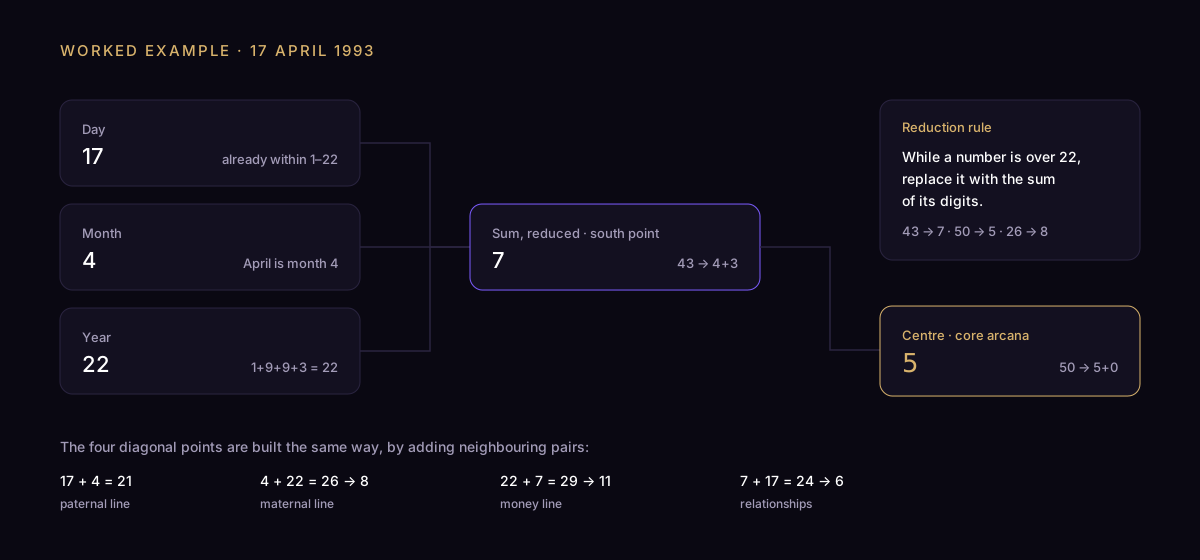
Apply it to the day, the month and the digit sum of the year, then add those three for the south point and all four for the centre. The diagonals are sums of neighbouring pairs. That is the whole system. The home page works it through step by step for a real date.
A property of the arithmetic worth knowing
Because reduction operates on decimal digits, the results are not evenly distributed. Some arcana come up considerably more often than others across all possible birth dates. This is a fact about base-10 arithmetic, not a fact about people, and any interpretation that treats a common arcana as ordinary or a rare one as special is reading meaning into a rounding artefact.
Why two calculators disagree
This is the most common complaint about the method, and it has boring, specific causes.
| Point of difference | Variants in circulation | What we use |
|---|---|---|
| Reducing the year | Sum all four digits, or use only the last two. | All four digits. |
| Reduction target | Reduce to 1–22, or reduce to a single digit first and then map. | Straight to 1–22. |
| Number of positions | Nine, or twenty-plus with additional lines and generational points added by later teachers. | Nine, because they are the ones every school agrees on. |
| Naming | Arcana 13 as Death or as Transformation; position names vary widely between translations. | Transformation, and the position names used throughout this site. |
There is no governing body and no canonical version, so "correct" is not available. What is available is consistency: pick one method, use it for every chart, and do not compare charts built with different rules. Ours is documented so that at least it can be checked.
What the arithmetic can and cannot support
Being clear about this is the whole reason the method is published openly on this site.
What it can do
- Produce the same nine numbers for the same date, every time, verifiably.
- Give you a fixed, non-arbitrary set of prompts to think about yourself with — the value of a structured question, which is real and does not require the structure to be true.
- Surface a tension you had not articulated, by forcing two positions to be read together.
What it cannot do
- Predict an event. Nothing in a date of birth contains information about the future.
- Diagnose anything. It is not a psychological instrument and has never been validated as one.
- Describe a person more accurately than that person can. Everyone born on your day has your chart.
There is no scientific evidence that a date of birth determines personality, compatibility or outcomes, and studies of comparable systems have not found effects. If you find a chart useful, it is almost certainly because a structured prompt makes you think, not because the date carries information. That is still a real benefit — it is just a different one.
Why descriptions feel so accurate
Anyone honest about this method has to address the feeling of recognition, because it is strong and it is the main reason people believe the results.
Two well-documented effects account for most of it. The Barnum effect: descriptions general enough to fit almost anyone are reliably rated as highly specific to oneself. And confirmation bias: once you have a description, you recall the episodes that match it and do not count the ones that do not.
This is why every arcana on this site is written with a balanced and an unbalanced column, and why the guides keep insisting you read both. Reading only the flattering half is exactly the condition under which the Barnum effect does its work. Reading both halves and having to choose is the closest this method gets to being a real question.
Frequently asked questions
Who invented the destiny matrix?
It is most often attributed to Natalia Ladini, whose books in the 2000s and 2010s popularised the octagram layout and the 22-arcana mapping used almost everywhere today. Later teachers have added positions and variants, and there is no single authority over the method.
Is the destiny matrix the same as numerology?
No, but it uses numerology's central technique. Numerology reduces to single digits and works with those; the destiny matrix reduces to the 1–22 range and maps the result onto tarot arcana, which numerology does not do.
Is it related to astrology?
Only in that both start from a birth date. Astrology uses the time and place of birth and the positions of celestial bodies; the destiny matrix uses none of those and cannot, since it works from the date alone.
Can the method be tested?
The arithmetic can — you can verify any chart by hand in two minutes. The interpretations cannot, in any meaningful sense: they are not specific enough to generate predictions that could fail.
Now read your own matrix
All 22 positions, free in the app. Or start with the calculator on the home page.